Home / Sunday-mid-day / Article /
Mithi river: Experts propose 5 ways that can alter the course of its future
Updated On: 19 March, 2023 09:52 AM IST | Mumbai | Jane Borges
An urbanist and environmental engineer pair curious about the potential of taming Mumbai’s most capricious river fashion five opportunities that can alter the course of its future





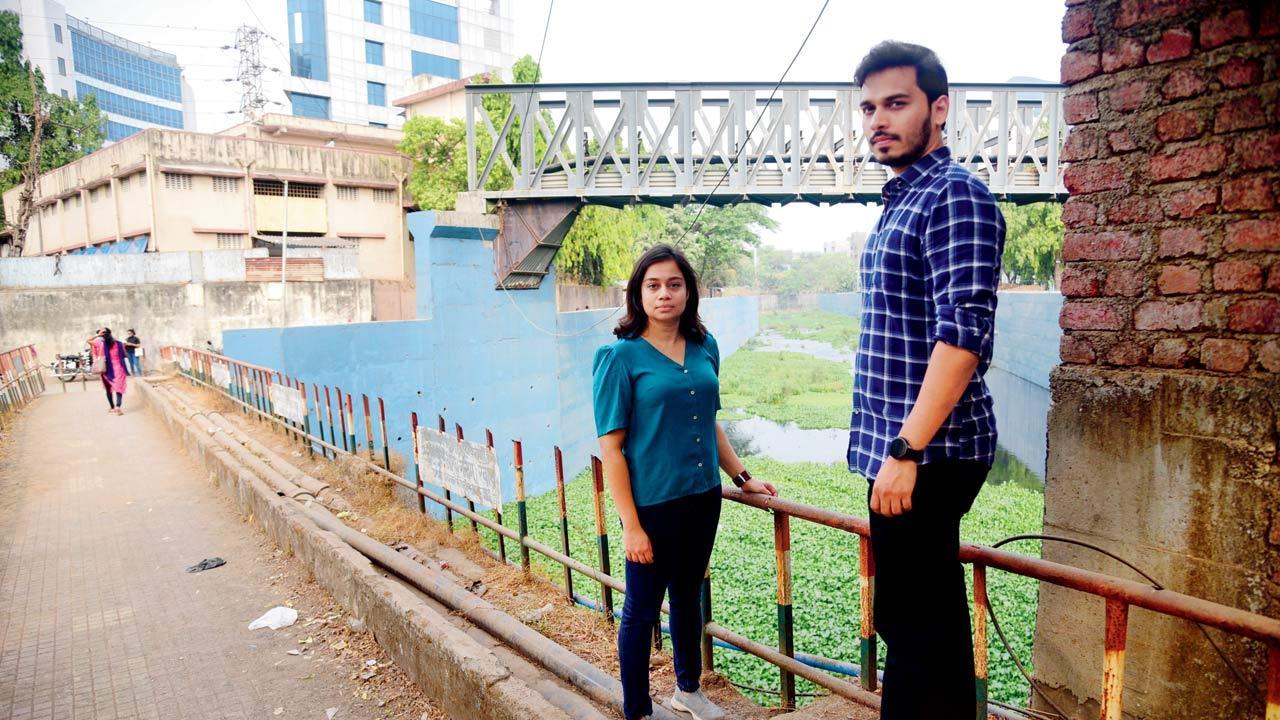
Urbanist Sahil Kanekar and environmental engineer Kartiki Naik of World Resources Institute (WRI) India stand on a bridge on the Mithi river. The river has been channelised using retaining walls (behind), as a flood-protection measure. Pics/Pradeep Dhivar
The Mithi river has a most curious relationship with the city. It’s the silent mover, still and languid on most days, forgotten almost, hidden between retaining walls, mixing daily with grime and filth without complain or too much push back. In the monsoon, it turns into an unrecognisable beast. Torrid, bumbling and rather, perilous. The deluge of 2005 was exacerbated by the raging Mithi river, leading to deaths and forced evacuations. Even today, every monsoon, the desilting of Mithi remains top priority for the Brihanmumbai Municipal Corporation.
Urbanist Sahil Kanekar and environmental engineer Kartiki Naik of World Resources Institute (WRI) India chanced upon the capricious Mithi River accidentally. “In 2021, the Marol Cooperative Industrial Estate approached WRI India to be a knowledge partner in the conceptualisation and development of a public space on a land parcel they owned,” says Kanekar, who is senior programme associate for urban planning at WRI India. “In the DP, this particular land parcel, which is along the path of the Mithi river was reserved as an open space—conceptualising it as a public space hence, made complete sense.” There was, however, one tiny issue. During development of the Mumbai Climate Action Plan (MCAP), WRI India had created a “heat stress map” or “land surface temperature” that highlighted the urban heat island effects within the city. “This space was among the locations found to be under tremendous heat stress,” says Kanekar. And so, instead of opting for a garden-like space, the team felt what had to be prioritised was increasing the tree cover on this land parcel, while making it accessible to citizens. The proposed urban forest hence, began with the primary objective of mitigating heat risk. A site visit led the team to discover more such land parcels further upstream. “We came up with a larger vision—what if we combined these land parcels together? We would be able to create a linear, kilometre-long park, where citizens could also enjoy a riverfront.”
Trending Stories
Latest Photos
Latest Videos
Latest Web Stories
ADVERTISEMENT
Mid-Day Fast
ADVERTISEMENT